Monet's Water Lilies: A Visit That Left My Heart Afloat

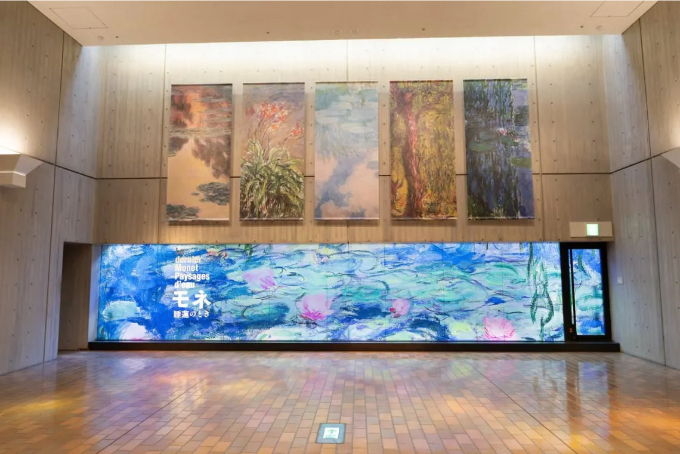
A few days ago, I finally caught — literally at the last possible moment — the monumental Monet exhibition I'd been longing to see. Claude Monet is one of my dearest painters, and unquestionably my favorite Impressionist.
I could not help thinking: If, centuries from now, crowds still gather in museums to contemplate my own work so intently, I would burst with joy — enough to lift the very lid of my coffin.
Billed as the largest Monet Water-Lilies show in Japanese history, the exhibition brought together sixty-four original canvases — most of them major works. Roughly fifty travelled from the Musée Marmottan Monet in Paris and were joined by masterpieces from the National Museum of Western Art in Tokyo and other Japanese collections. The result was nothing short of breathtaking.
I queued for an hour and a half before I finally secured a ticket, yet it was — without question — the finest exhibition I have attended in years. With an audio guide in my ears, the sea of onlookers faded away; I slipped into Monet's universe, entirely alone with the paintings.
Four Halls, Five Chapters — A Soul in Motion
The show unfolded across four galleries and five thematic chapters: from Monet's initial vision for the Water-Lily series and the creation of his garden pond, through the trials of war and the shadow of cataracts. What hung before me were not merely paintings, but the unfolding of a soul.
In the early chapters I savored the serenity and lush colors: Monet had poured his heart into that pond, observing day after day how light and shadow danced upon the lilies. Gazing at the canvases, one felt dawn and dusk, a fiery sunset, tranquility interwoven with richness — rugged strokes married to delicate nuance.
The later chapters moved me in another way. These works belong to Monet's final years, when he wrestled with the horrors of World War I and with advancing cataracts. The compositions grow wilder, the palette more incandescent. Yet within the storm one still senses Monet's exquisite sensitivity to life and beauty — a defiance of fate, a lament for the suffering of innocents.
Painting Against the Dimming Light
For years Monet's eyesight deteriorated. While he painted the Japanese Bridge canvases, his cataracts grew severe; by ninety-three his right eye was nearly blind. An operation restored a little clarity — tinged forever with yellow-green distortion — yet he would not stop painting:
When a singer loses their voice, they retire. When a painter undergoes cataract surgery, they are expected to lay down the brush. But giving up painting is the one thing I absolutely cannot do.
Towering Willows, Blazing Trunks
Among my favorites were several monumental paintings of weeping willows. One in particular loomed as though viewed from below: no sky, only willow from edge to edge, its crimson trunk cutting bold and vertical through the canvas while cascading foliage filled every corner. The sheer scale spills beyond the frame and strikes the viewer straight in the heart.
A small anecdote:
Three Japanese visitors once observed Monet at work on a red-trunked willow. One, puzzled, asked whether such colors could be "correct."
Monet replied with a smile:
"You know, those older paintings of mine — whose colors you now praise — were once condemned as bizarre. So if these hues appear strange today, rest assured: one day people will marvel at how beautiful they are."
Years later, after Monet's death, his Water-Lily panoramas entered museum halls and captured the hearts of the public.
The Rose Walk and the Last Glimpse of Home
Beside the pond Monet built a rose-covered arbor. House Seen through the Roses — three canvases forming his final series — shows that view. The mingled colors are sublime; in the upper left a hint of the house peeks through, the home where he had lived for more than forty years.
Sooner or later, Monet confessed, everything I see will warp and become bewildering. Such a state is unbearable. If I can no longer behold nature as I do now, I would rather remain blind, preserving in memory the beauty I have always known.
When the Great War erupted in 1914, Monet plunged into vast compositions, saying that work spared him the grief of the times:
I am ashamed, studying these tiny nuances of color and form, while so many are dying and suffering.
After the armistice, in November 1918, he wrote to his old friend, Prime Minister Georges Clemenceau, offering two works to celebrate peace. The willow stood for mourning; Monet imagined viewers entering a meditative calm, enveloped by infinite, painted waters where real willow and reflected willow merge, reality and illusion dissolving in motion.
In another canvas a single willow trunk bends toward its own reflection — like a figure bowing in silent grief.
Notes in Motion
Most of what you have read I jotted while walking; only the third gallery allowed photographs (eight pieces), and writing by hand deepened the memory. The special exhibition occupied two basement levels — so deep that even mobile signals failed, a perfect excuse for immersion. The audio guide lifted the experience several stories higher; I recommend it without reservation. Though the show was not large, I lingered for more than three hours.
Tokyo's run has ended, but the exhibition will travel on to Kyoto — there is still time if you missed it. It is a triumph of curatorial care and scholarly depth. The museum shop proved irresistible: postcards, the limited-edition catalogue — souvenirs of an unforgettable day. Crowd aside, I give the show my highest praise.
For a quick flip-through of the catalogue, see my video on X: https://x.com/Philo2022/status/1890294639682601296
Enjoyed this post?
Subscribe to get new posts delivered to your inbox.